
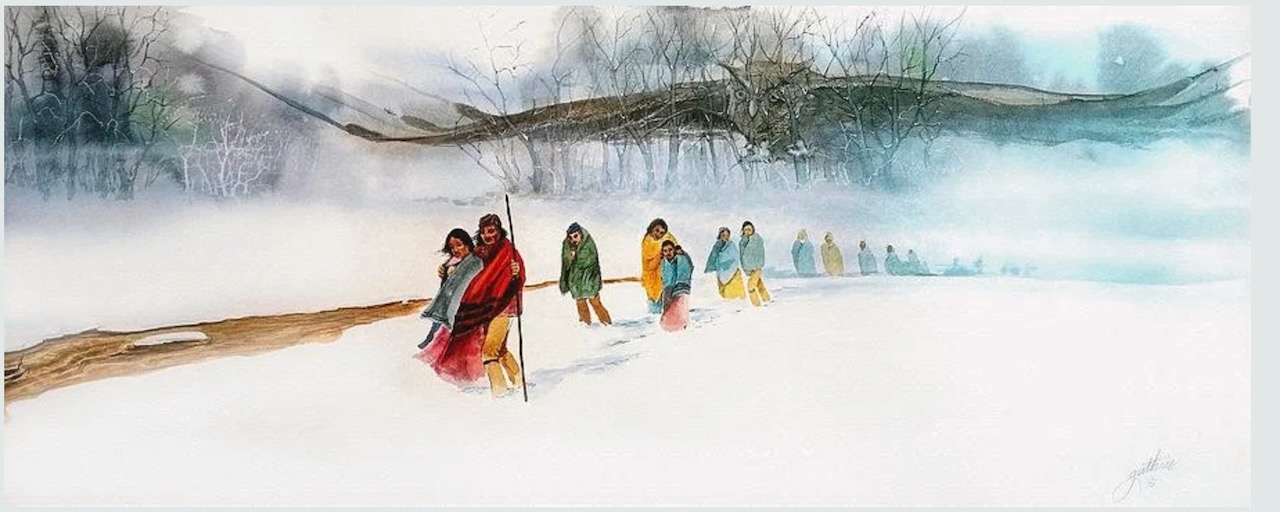
The Cherokee and Europeans gathered in Georgia in 1765 to negotiate a treaty. This was before the Trail of Tears began in 1830. Imagine the shock on both sides when the Cherokee peace chief Attakullakulla looked around and asked, “Where are your women?”
We could ask that today.
In 1992 when my daughter was 8 years old (and the Green Party of CA became ballot-qualified) we were listening to the radio about the presidential election. She suddenly asked, “Mom! Why are all the presidents boys?”
She could ask that today.
I recently saw an art exhibit about the Etruscans who lived in Italy in times before the Greek and Roman empires about 2000 years ago. As one of many significant discoveries, it was found that the Etruscan banquets included women, while the banquets of the empires that took them over, the Romans and Greeks, were all male.
Today, we can look at the representation of women in a variety of areas:
- US house of representatives (28.5%)
- US Senate (27%)
- CA governors (0%)
- Average wage in US (in 1963 women got $1.00 while men averaged $1.69; in 2026 it’s $1.00 to $1.22)
- US movies (2026 Academy Awards, 27% of non-acting nominees were women)
- In 2026, the number of women running for public office… alas, about the same as these other percentages, the pattern continues.
Any suggestions?
Please do not believe it’s just a big problem for individual women. It’s a big problem for anyone who would like a strong social movement to advance our country toward more access to high quality and affordable healthcare; better education with genuine opportunity for all and without student debt; a roof over everyone’s head; fairness, justice and freedom inside our country and in our dealings with other countries. Imagine if half the population were not kept to 27%.
NOTE: For this “Where are your women?” blog post I thought about using an image of a wall-sized mural that recently stunned me in Mexico City at the Palacio de Bellas Artes — but I didn’t have the nerve. It’s part of a mural by David Alfaro Siqueiros, a contemporary of Diego Rivera, called “Nueva democracia.”
IMAGE: Shadow of the Owl by John Guthrie, Cherokee Trail of Tears, 1830-1850